 02 September 2026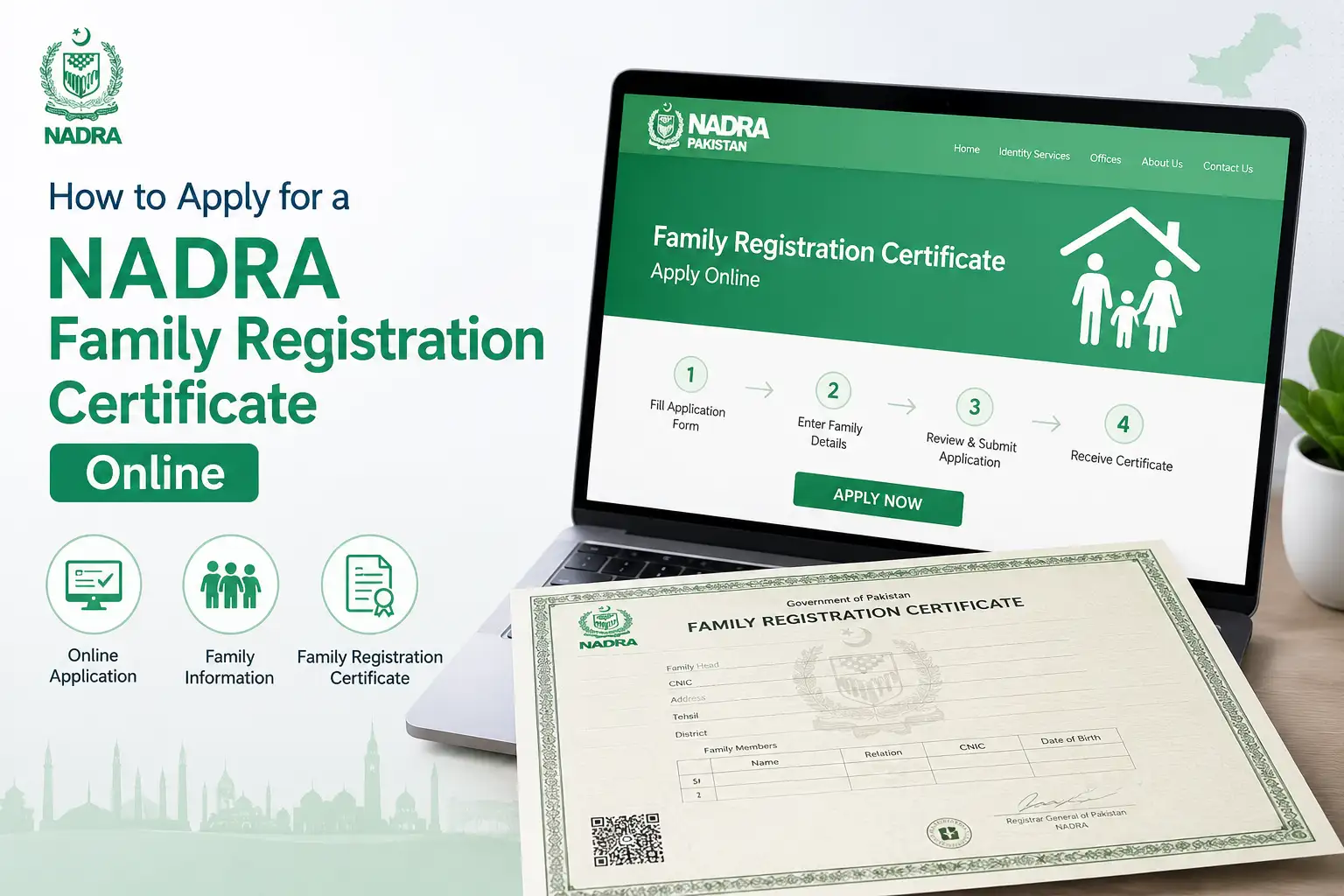
If you've ever applied for a spouse visa, sponsored a family member's immigration, or dealt with an inheritance matter, you've probably run into a request for something called a Family Registration Certificate. It sounds like a small bureaucratic detail, but a lot of official processes simply won't move forward without it. The good news is that getting one no longer requires standing in line at a NADRA office all day, since the entire application can now be completed online. Here's exactly how it works.
What an FRC Actually Is
A Family Registration Certificate, usually just called an FRC, is an official document issued by NADRA that lists your registered family members and how they're related to you, whether that's parents and siblings, a spouse and children, or a guardian and adopted children. It's essentially a government verified snapshot of your family structure as it exists in NADRA's database, and it carries legal weight in a way that a casual family tree simply doesn't.
Embassies, immigration authorities, universities, and courts all rely on this document because it comes directly from an official national database rather than something you could write up yourself. If a process asks you to prove your family relationships in any formal capacity, there's a good chance an FRC is exactly what's being requested.
The Different Types of FRC
NADRA issues FRCs in a few categories depending on what you actually need to prove.
A birth based FRC covers your parents and siblings, and is typically used when you need to prove family relations by birth, such as certain inheritance or legal matters.
A marriage based FRC covers your spouse and children, and this is the one most commonly required for visa applications and immigration sponsorships, since it establishes your immediate family unit.
A combined FRC covers both your birth family and your married family together in a single certificate, which some processes specifically ask for instead of two separate documents.
There's also a category for guardianship and adoption, designed specifically for families where a child has been legally adopted, so that relationship is reflected accurately on the certificate as well.
Before You Apply: Make Sure Everyone Is Registered
This is the part that trips people up the most. NADRA can only include family members in your FRC if they're already registered in the system with their own CNIC, B Form, or equivalent identity document. If a sibling, spouse, or child hasn't been registered yet, or if their record has an outdated or incorrect detail, you'll need to get that sorted first, since the FRC simply won't generate correctly around a missing or mismatched family member.
It's worth checking this in advance rather than discovering it mid-application, since fixing a missing registration takes a separate visit to a NADRA Registration Center and will delay your FRC until it's resolved.
How to Apply for an FRC Through the Pak Identity App
This is the most common way people apply these days, since it can be done entirely from your phone without visiting an office.
- Download the Pak Identity app from the Google Play Store or Apple App Store, and confirm it's the official NADRA published version
- Create an account or log in using your CNIC number
- Verify your mobile number through the OTP sent to you
- Complete facial verification, the app will use your camera to scan your face and confirm your identity
- Once logged in, tap on New Application and select Family Registration Certificate
- Choose the FRC category you need, birth, marriage, combined, or guardianship
- Review the family members that appear based on your NADRA record, and confirm the details are accurate
- Pay the applicable fee through a debit or credit card, JazzCash, or Easypaisa
- Submit your application
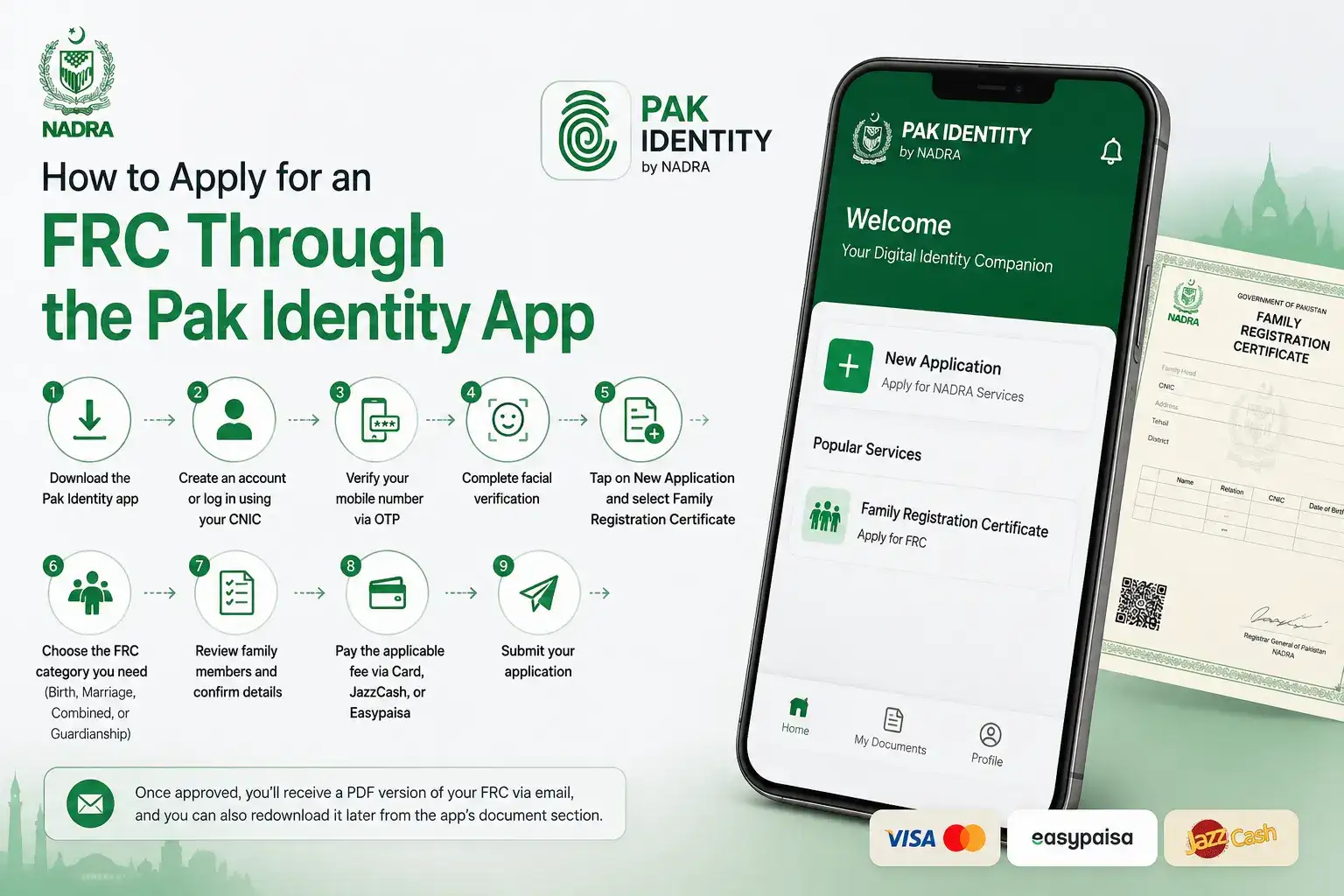
Once approved, you'll receive a PDF version of your FRC via email, and you can also go back into the app's document section to redownload it later if needed.
Applying Through id.nadra.gov.pk
If you'd rather use a browser instead of the app, NADRA's web portal at id.nadra.gov.pk offers the same FRC application process. This route is especially useful for overseas Pakistanis, who can log in using their NICOP (the identity card issued to Pakistanis living abroad) and complete the entire application without needing to be physically present in Pakistan.
The steps are essentially the same as the app: log in, verify your identity, select the FRC category, review your family details, pay the fee online, and submit. The certificate then gets emailed to you in PDF form once it's processed.
Applying In Person at a NADRA Registration Center
If you're not comfortable with the online process, or you'd rather get the certificate the same day, visiting your nearest NRC remains a completely valid option. Bring your original CNIC, and staff will guide you through selecting the correct FRC category and confirming your family details. In person applications are often issued the same day, sometimes within the hour, provided there are no discrepancies in the family records involved.
FRC Fees
As of 2026, the standard FRC fee is Rs. 1,000, and this applies whether you're applying for the standard, urgent, or executive category, since NADRA doesn't charge extra for urgent processing on FRCs specifically, they're usually issued instantly once your family records are verified with no issues. A combined FRC covering both birth and married family together typically costs Rs. 2,000. Since fee structures do get revised occasionally, it's worth double-checking the current amount directly on NADRA's official website before you apply, just to be safe.
How Long It Takes
If you apply online, your FRC is generally emailed to you as a PDF within 24 hours of submission, assuming your family records are accurate and complete. If you apply in person at an NRC, it's often issued within a few hours the same day. The only real cause for delay is if something in your family's records needs to be corrected or updated first, in which case the certificate simply can't be generated until that's resolved.
What to Do If Your Application Gets Delayed
If your FRC hasn't arrived within the expected timeframe, the most common reason is a mismatch or missing detail somewhere in your family's registration, perhaps a sibling's CNIC has outdated information, or a child was never formally registered. In this case, checking your application status through the Pak Identity app will usually tell you if something needs attention. If it's unclear what the issue is, visiting your nearest NRC in person and asking staff to review your specific case is the fastest way to get a clear answer.
Frequently Asked Questions
Can I apply for an FRC entirely online without visiting a NADRA office?
Yes, both the Pak Identity app and id.nadra.gov.pk allow you to complete the full FRC application online, and the certificate is emailed to you as a PDF.
What is the FRC fee in 2026?
The standard FRC fee is Rs. 1,000, and a combined FRC covering both birth and married family costs Rs. 2,000. NADRA doesn't charge extra for urgent processing.
Can overseas Pakistanis apply for an FRC online?
Yes, overseas Pakistanis can log in to id.nadra.gov.pk using their NICOP and complete the entire application without needing to visit Pakistan in person.
What happens if a family member isn't registered with NADRA yet?
They'll need to be registered first, since NADRA can only include verified, registered family members on the certificate. This may require a separate visit to an NRC.
How long does it take to receive an FRC?
Online applications are typically emailed within 24 hours, while in-person applications at an NRC are often issued the same day, sometimes within a few hours.
Documents You'll Need Alongside Your CNIC
While the FRC application itself pulls most of its information directly from NADRA's existing database, having a few supporting documents ready can save you from delays, especially if any part of your family record needs updating during the process. For a marriage-based FRC, having a copy of your Nikah Nama or marriage certificate on hand is useful in case NADRA's system needs to verify the marital link. If you're applying for a combined FRC or one involving children, having their B-Form or CNIC details ready speeds things along as well. In cases involving a divorce or khula, a registered divorce certificate matters too, since an unregistered separation can cause an ex-spouse to still appear on the certificate, which usually isn't what applicants want.
None of these documents typically need to be uploaded during a routine FRC application if your family records are already accurate and up to date, but keeping them accessible means you're not scrambling to find them if NADRA flags a discrepancy partway through.
Common Situations Where You'll Need an FRC
It helps to know the specific scenarios where this document tends to come up, since it's easy to underestimate how often it's actually required. Spouse and family visa applications are probably the most common reason people apply, since embassies want official proof of the family relationship being claimed rather than just a self declared statement. Property inheritance cases are another major one, where legal heirs often need to formally establish their relationship to a deceased family member before an estate can be divided. University admissions abroad, sponsorship applications for family reunification, and even some domestic legal proceedings involving custody or guardianship can also require an FRC as supporting evidence.
If you're not sure whether your specific situation needs one, it's worth checking directly with whichever institution, embassy, court, or university, is requesting your documents, since requirements can vary slightly depending on the exact process you're going through.
Updating Your FRC After a Life Change
An FRC reflects your family record at the moment it's issued, which means a marriage, divorce, birth, or death in the family will make a previously issued certificate outdated. If you've recently gone through any of these changes, it's worth applying for a fresh FRC rather than relying on an older one, especially for anything formal like a visa application, since authorities generally expect the certificate to reflect your current family situation rather than one from a few years back.
The good news is that updating an FRC follows essentially the same process as applying for a new one, through the Pak Identity app or id.nadra.gov.pk, as long as the relevant life event, like a registered marriage or divorce, has already been reflected in NADRA's underlying records. If it hasn't been updated yet, that update needs to happen first, usually through a visit to an NRC, before a new FRC reflecting the change can be generated.
Applying for a Family Registration Certificate really doesn't take much time once your family's records are in order. Whether you go through the Pak Identity app, id.nadra.gov.pk, or an in person visit to an NRC, you'll have an official, government verified proof of your family structure in hand well before whatever deadline you're working against.