
 19 August 2026
If you've ever tried to launch a website in Pakistan, you already know the drill. You search "best web hosting in Pakistan," open ten tabs, and every single one claims to be the fastest, cheapest, and most reliable option out there. A few weeks later, you're still stuck, unsure whether to trust a local provider you've never heard of or pay extra for a global brand that doesn't even bill in rupees.
Here's the short version: web hosting is the service that keeps your website's files, images, and databases stored on a server so people can actually visit your site 24/7. But which hosting company you pick affects your loading speed, your search engine rankings, your uptime during traffic spikes, and how quickly someone answers the phone when something breaks at 2 a.m. This guide walks through everything you actually need to know before choosing a web hosting service in Pakistan in 2026, without the sales pitch.
Why Your Hosting Choice Matters More Than You Think
A lot of first time website owners treat hosting as an afterthought something you pick in five minutes just to get the site live. That's usually a mistake. Your hosting provider directly affects three things Google cares about: page speed, uptime, and server response time. All three are ranking factors, which means cheap, unreliable hosting can quietly work against your SEO no matter how good your content is.
There's also a very Pakistan specific angle here. If most of your visitors are browsing from Karachi, Lahore, or Islamabad, and your server sits in a data center in Europe or the US, every single page request has to travel that distance and back. That round trip adds real, measurable delay. A server located in Pakistan, or at least on a content delivery network (CDN) with a node covering the region, will almost always load faster for a local audience than a far off international server will.
Types of Web Hosting Available in Pakistan
Not every website needs the same kind of hosting. Here's a quick breakdown of the main options you'll come across while shopping for a plan.
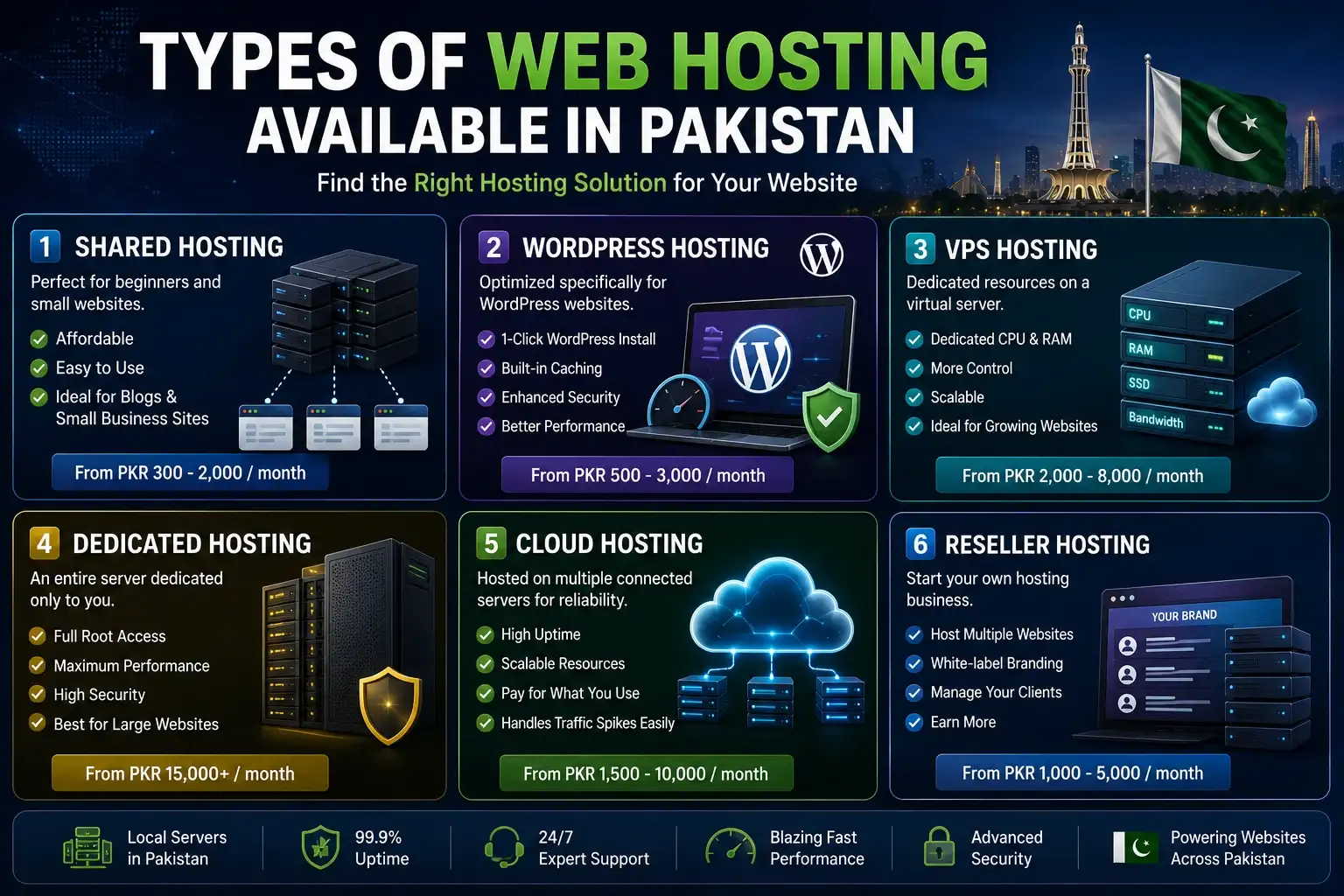
Shared Hosting. This is the entry point for most new websites blogs, portfolios, small business sites. You share server resources with other websites, which keeps the cost low, usually somewhere in the range of a few hundred to a couple thousand rupees a month. The trade off is that a traffic spike on someone else's site on the same server can occasionally slow yours down.
WordPress Hosting. Since a huge share of websites in Pakistan run on WordPress, most hosts now offer WordPress optimized plans. These typically come with one click installs, built in caching, and pre configured security settings specifically tuned for WordPress sites, so you're not manually installing plugins to get decent performance.
VPS (Virtual Private Server) Hosting. A step up from shared hosting, a VPS gives you a dedicated slice of server resources your own CPU and RAM allocation even though you're technically still sharing a physical machine. It's a solid middle ground for growing businesses or sites with moderate to high traffic that have outgrown shared hosting but don't need a full dedicated server yet.
Dedicated Hosting. This is the whole server, just for you. It's the most expensive option, but it also gives you full control and maximum performance, which makes sense for large e-commerce platforms or high traffic applications.
Cloud Hosting. Instead of relying on a single physical server, cloud hosting spreads your website across a network of connected servers. If one server has an issue, another picks up the load, which generally means better uptime and easier scaling during sudden traffic surges.
Reseller Hosting. Popular among freelancers and small web development agencies in Pakistan, reseller hosting lets you buy hosting resources in bulk and resell them to your own clients under your own brand.
Local Hosting vs. International Hosting: Which One Actually Makes Sense?
This is probably the single most common question Pakistani website owners ask, and honestly, the answer depends on your audience.
If your visitors are mostly based in Pakistan, a local hosting provider generally has the edge. You get PKR pricing, so your costs aren't tied to constant rupee to dollar fluctuations, local payment options like JazzCash, EasyPaisa, or direct bank transfer, and support teams working in Pakistan Standard Time who understand local infrastructure quirks like load shedding and PTCL latency issues.
If your audience is international say you're running an e-commerce store selling to US or European customers, or you're a freelancer with overseas clients an international provider with a global content delivery network might actually serve you better, even with the added friction of USD billing and support hours that don't line up with your own.
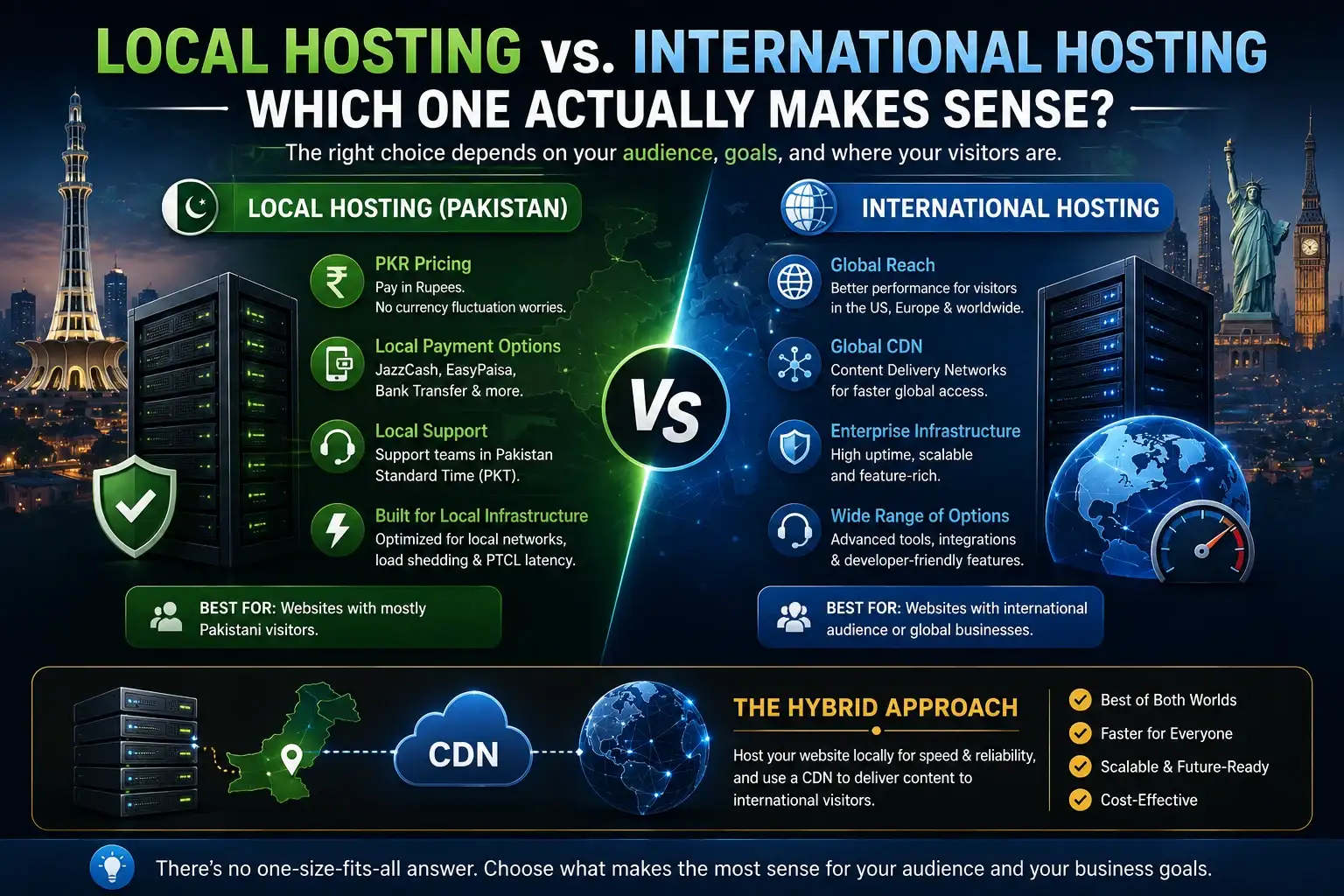
A growing number of buyers end up going hybrid: hosting the site itself locally for speed, while layering a CDN on top for any international visitors.
What to Check Before You Buy Any Hosting Plan
Skip the marketing buzzwords for a second and focus on these practical checkpoints instead.
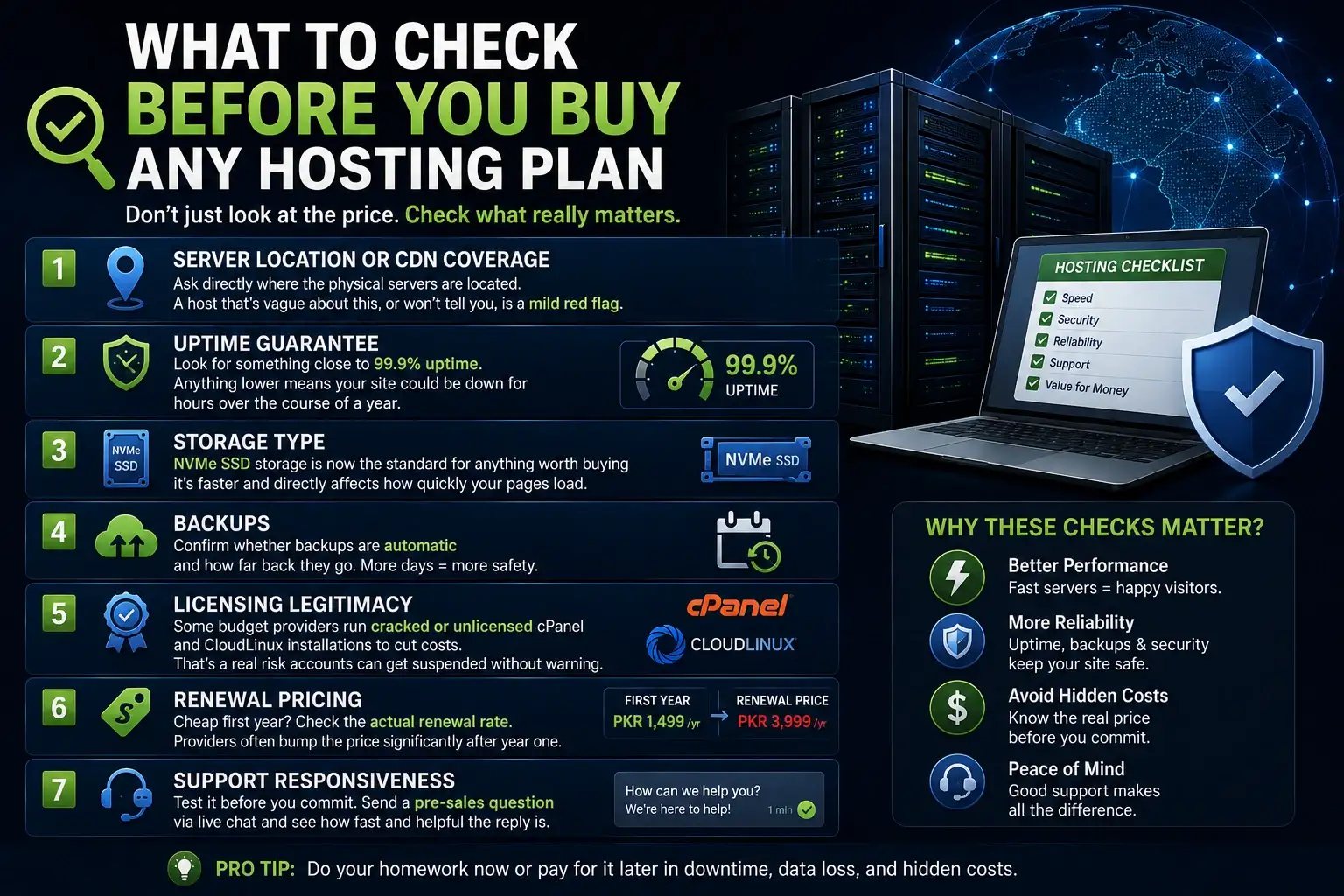
Server location or CDN coverage. Ask directly where the physical servers are located. A host that's vague about this, or won't tell you, is a mild red flag.
Uptime guarantee. Look for something close to 99.9% uptime. Anything lower means your site could be down for hours over the course of a year, which adds up fast if you're running an online store.
Storage type. NVMe SSD storage is now the standard for anything worth buying it's noticeably faster than older HDD or even basic SSD setups, and it directly affects how quickly your pages load.
Backups. Confirm whether backups are automatic and how far back they go. A host offering only 24 hour backups leaves you exposed if you don't catch a problem right away.
Licensing legitimacy. This one surprises a lot of buyers, but some budget providers run cracked or unlicensed cPanel and CloudLinux installations to cut costs. That's a real risk accounts on illegitimate licenses can get suspended without warning.
Renewal pricing. This is where a lot of "cheap hosting" turns out to be a trap. Providers frequently offer a rock-bottom introductory price for the first year, then bump the renewal price significantly. Always check the actual renewal rate before signing up, not just the promotional price on the homepage.
Support responsiveness. Test it before you commit if you can. Send a pre sales question through live chat and see how fast and how helpful the reply actually is.
How Much Does Web Hosting Cost in Pakistan?
Pricing varies quite a bit depending on the provider and plan type, but here's a realistic range for 2026:
- Shared hosting: Roughly PKR 1,500 to PKR 6,000 per year for basic plans
- WordPress hosting: Around PKR 5,000 to PKR 15,000 per year, depending on resources and included features
- VPS hosting: Typically starts around PKR 3,000 to PKR 4,000 per month and scales up from there based on CPU and RAM
- Dedicated servers: Usually starts well above PKR 15,000 per month, climbing based on server specs
Most plans in this range include a free SSL certificate, cPanel access, and at least one free domain for the first year so it's worth comparing what's bundled in, not just the sticker price.
Common Questions About Web Hosting in Pakistan
Is local hosting actually better for SEO than international hosting?
For a Pakistani audience, yes, generally. Faster load times for local visitors translate into better user experience signals, which search engines factor into rankings. That said, the effect is secondary content quality, backlinks, and site structure still matter far more.
Can I get a domain and hosting from the same provider?
Yes, and it's usually more convenient. Most Pakistani hosting companies let you register a domain and purchase hosting in a single checkout, and some even throw in the domain free for the first year with an annual hosting plan.
Do I need a professional business email with my hosting?
It's not required, but it's strongly recommended if you're running a business. A custom email address like [email protected] looks far more credible than a generic Gmail account, and most paid hosting plans already include email hosting at no extra cost.
What happens if I outgrow my current hosting plan?
Reputable providers make upgrading painless. You can typically move from shared hosting to VPS, or from a smaller VPS to a larger one, without needing to migrate your entire site from scratch.
Is cheap hosting always a bad idea?
Not necessarily, but it depends on what's behind the low price. A budget plan with SSD storage, real uptime numbers, and transparent renewal pricing can be perfectly reliable. The real problem is hosting that's cheap because it's cutting corners on backups, licensing, or support.
Top 10 Web Hosting Services in Pakistan
If you'd rather skip the research and just see who's actually worth considering, here's a rundown of ten hosting providers that consistently show up as solid choices for Pakistani website owners, whether you're after local PKR pricing or a globally recognized brand.
1. Hostinger — Hostinger is one of the most popular hosting brands among Pakistani users, and for good reason. It's known for budget friendly plans, NVMe SSD storage, a beginner friendly control panel, and an AI assisted website builder that makes it easy for total beginners to get a site live fast. It's a strong pick whether you're launching your first blog or running a small WordPress business site.

2. HosterPK — A long-running local provider offering shared, VPS, and dedicated hosting with PKR billing and local support. It's popular with startups and individuals looking for affordable entry-level plans.
3. Truehost PK — Known for extremely low starting prices, PKR billing, and local payment methods like JazzCash and EasyPaisa. A solid pick for freelancers, bloggers, and small businesses just getting started.
4. Navicosoft — One of the more established names in the market, with ICANN accredited domain registration alongside hosting, plus a global data center network for buyers who need more than just local coverage.
5. WebHoster.pk — Offers NVMe SSD servers, 24/7 local support, and a straightforward refund policy, making it a reliable option for businesses that want performance without excessive complexity.
6. HostBreak — Operating since 2001, HostBreak is one of Pakistan's oldest hosting companies, with a large customer base and plans that bundle DNS management, email hosting, and free migration.
7. WebSouls — Running since 2002, WebSouls stands out for having walk-in offices in Lahore, Karachi, and Islamabad — a rare option if you actually want in person support.
8. Middlehost — A newer but fast-growing local provider focused on performance features like LiteSpeed caching, aimed at Pakistani businesses that want speed alongside solid support.
9. Bluehost — A globally recognized brand with strong WordPress integration, reliable uptime, and scalable plans, making it a good fit for Pakistani users who want an internationally established name.
10. Namecheap — Well known for affordable domain registration alongside hosting, Namecheap is a good option for buyers comfortable with USD billing who want a globally trusted provider.
Whichever name you go with, the same rule applies: compare renewal pricing, confirm what's actually included, and don't assume the cheapest first-year price tells the whole story.
Making Your Final Decision
Choosing a web hosting service in Pakistan really comes down to matching the provider to your actual situation your audience, your budget, and how much technical hand-holding you expect to need along the way. A simple blog or portfolio site can run comfortably on basic shared hosting for a few hundred rupees a month. A growing e-commerce store or business platform, on the other hand, is usually better off on VPS or cloud hosting from day one, even if it costs a bit more upfront.
The smartest approach is to start with a plan that covers your current needs without overpaying for capacity you won't use for a year, then upgrade as your traffic actually justifies it. Whatever you choose, don't skip the boring parts check the renewal pricing, confirm the server location, and make sure backups are genuinely automatic. Those three details tend to matter a lot more, long term, than whichever provider has the flashiest homepage.